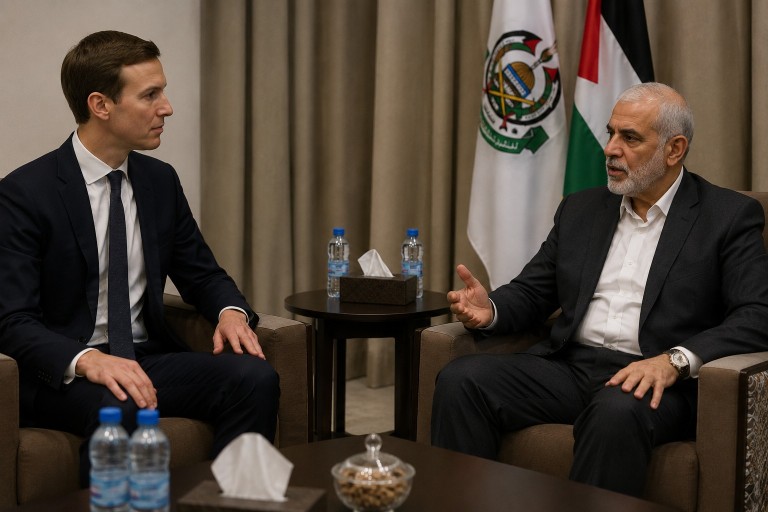
On Sunday, Jared Kushner, senior advisor to former President Donald Trump and a key figure in U.S. foreign diplomacy, engaged in talks with Hamas political leader Khalil al-Hayya in Egypt. This meeting is part of the United States’ renewed efforts to rekindle a stalled ceasefire agreement in Gaza. Kushner’s diplomatic mission precedes a planned meeting with Israeli Prime Minister Benjamin Netanyahu, who has recently dismissed a U.S.-endorsed 15-point plan aimed at advancing the ceasefire.
The proposed plan seeks to establish a gradual disarmament of Hamas in exchange for Israel ceasing its military operations and withdrawing from specified areas of Gaza. Additionally, the plan outlines strategies for rebuilding the region and the introduction of international forces to sustain security. While Hamas has expressed its support for the roadmap, it insists that Israel cease its attacks and retreat to the established “yellow line” before any actions are taken. Moreover, Hamas has linked the surrender of its more formidable weaponry to the advancement of a Palestinian state, a concept that Netanyahu’s administration does not support.
Netanyahu remains firm in his stance that Israeli forces will not complete their withdrawal from Gaza until Hamas is fully disarmed, creating a significant impasse that has delayed essential components of the ceasefire initiative, such as reconstruction efforts and the induction of international peacekeeping forces. Kushner’s encounter with Hamas, which was also attended by representatives from Egypt, Qatar, and Turkey, was designed to secure Hamas’s agreement to the disarmament conditions of the plan ahead of his talks with Netanyahu.
In addition to meeting Netanyahu, Kushner is set to hold discussions with former British Prime Minister Tony Blair and Nickolay Mladenov, the Director of the Board of Peace. The road map’s rejection by Israel has garnered criticism from several regional nations, including Saudi Arabia, the United Arab Emirates, Jordan, Pakistan, and Indonesia, all of whom have called for immediate measures to prevent further postponement of the peace process.
This diplomatic initiative coincides with a politically sensitive period for Netanyahu, who is facing mounting pressure ahead of Israel’s elections in October. His governing coalition includes ministers advocating for a more stringent approach towards Gaza, casting doubt on the ultimate fate of the ceasefire and the broader peace plan.