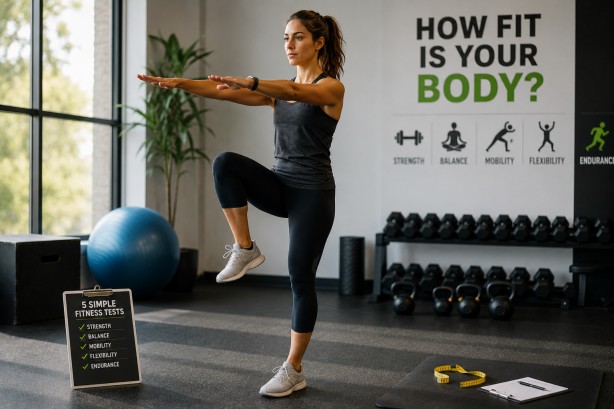
Fitness encompasses much more than just the ability to lift weights or run long distances; it includes the capacity to perform everyday movements such as squatting, standing up from the floor, and maintaining balance. These activities can offer valuable insights into one’s functional fitness. Five exercises, which can generally be performed at home with little or no equipment, are designed to assess various aspects of physical ability, such as strength, flexibility, mobility, grip, and balance. However, it is crucial to perform these exercises safely.
The deep squat hold is one of these exercises. To perform it, stand with your feet about hip-width apart, lower yourself into a squat while keeping your heels on the ground, and hold the position for up to 60 seconds without support. This exercise tests mobility in the ankles, knees, and hips, as well as lower-body strength and control. If holding the position is uncomfortable or if your heels lift off the floor, it may suggest that your lower-body control or mobility needs attention.
Another exercise is the dead hang, which involves gripping a secure pull-up bar and holding your body off the ground with extended arms for about 30 seconds. This movement assesses grip strength and upper-body endurance and requires shoulder stability and control. Beginners should ensure the bar is properly secured and avoid this exercise if they have injuries that could worsen by hanging.
Functional fitness can also be evaluated by sitting on the floor and attempting to stand without using hands, knees, or forearms for support. This movement requires a blend of lower-body strength, balance, coordination, and mobility. While difficulty in performing this task may highlight areas for improvement, it’s important to note that performance can vary greatly due to factors like age, flexibility, previous injuries, and fitness level.
Additional exercises include the forward fold, which tests flexibility by seeing how far one can bend forward with straight legs and the single-leg balance, which involves standing on one leg and maintaining balance, with eyes closed to increase difficulty. These activities provide a snapshot of several components of functional fitness, such as strength, mobility, and coordination. While these exercises are not diagnostic tools, and performance can be influenced by various factors, they can guide individuals in identifying areas for gradual improvement through consistent exercise.