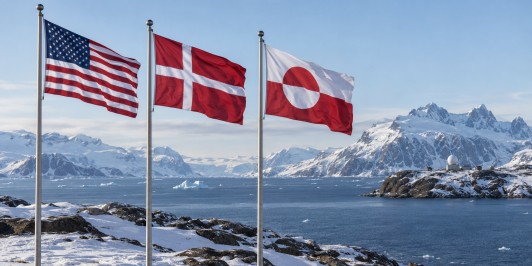
Amid escalating geopolitical tensions in the Arctic, the United States, Denmark, and Greenland have reached a pivotal agreement to bolster security cooperation across the region. Signed during the United Nations General Assembly in New York, the trilateral pact allows for an expanded American military presence on Greenland, a strategically important island between North America and Europe.
The agreement, endorsed by US President Donald Trump, Danish Prime Minister Mette Frederiksen, and Greenland Prime Minister Jens-Frederik Nielsen, marks a significant shift in military strategy in the Arctic and North Atlantic. It enables the United States to establish new defense zones at Narsarsuaq and Mestersvig and to develop the “Golden Dome” missile defense system in Greenland, enhancing its strategic capabilities in the area.
This accord builds upon the existing 1951 US-Denmark defense agreement by granting broader access to US aircraft and vessels within Greenland’s territory and surrounding waters. Importantly, it also enforces restrictions on non-NATO countries, preventing them from setting up military bases on the island and limiting foreign investments in crucial sectors such as critical infrastructure and resource extraction.
Despite these expansions, the agreement respects the sovereignty of the Kingdom of Denmark and acknowledges Greenland’s right to self-determination. For the deal to be fully implemented, it must receive parliamentary approval in both Denmark and Greenland, ensuring that local governance structures are recognized and upheld.
This development follows a period of heightened interest from the United States in acquiring Greenland, driven by its strategic location and abundant mineral and energy resources. While the agreement stops short of transferring control of Greenland to the US, it represents the most significant increase in American military infrastructure on the island since the Cold War, supplementing existing operations at the Pituffik Space Base in northwestern Greenland.